Showing posts with label the fool reviews. Show all posts

Wednesday, February 29, 2012

The Fool Reviews Pirates of the Caribbean: On Stranger Tides

drink up, me hearties

Hello, everyone, and welcome to another installment of The Fool Reviews. Today, we're going to be looking at the latest installment in the well-known Pirates of the Caribbean franchise, On Stranger Tides.

Now, before we begin, I think it's important to establish that I am a big fan of the first three movies. I don't pretend that they're perfect. In fact, I consider both Dead Man's Chest and At World's End to be pretty damn terrible. But they're guilty pleasures to me, because, despite all the terribly confused mythology, awful pacing, groan-inducing attempts at humor, and the lackluster acting of Keira Knightley, there are good movies buried under there. They shine through in places, and I enjoy the hell out of those scenes. I can take the rest of the stupid for those few moments that match the sheer fun of the first film.

Which brings me to my next point. The highlight of all three of the first movies, in my opinion, was not Jack Sparrow. As the comic-relief-slash-deuteragonist of the first film, I found him engaging, but far from capable of carrying the movie on his own. No. To me, the greatest, most enduring character of the Pirates franchise is Captain Barbossa.


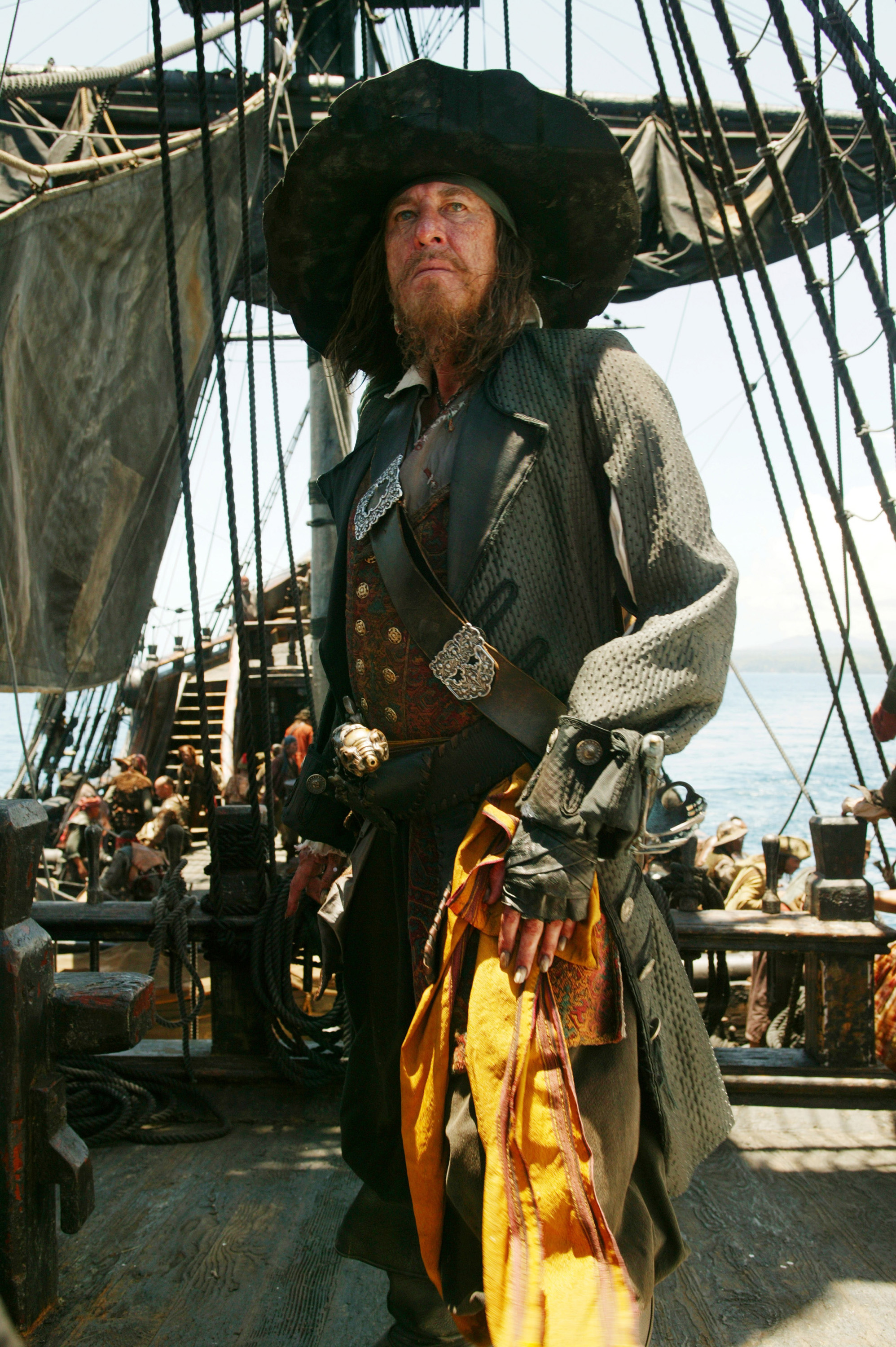
Look at this guy. This guy is fucking brilliant. This guy is pirate fiction incarnate. He's commanding. He's charismatic. He's an antagonist that never loses that threatening, menacing edge even when he undergoes a heel face turn. He's a magnificent bastard that basically carried the entire original trilogy. Geoffrey Rush is brilliant in this role. He's actually one of my favorite film characters of all time, and the ending of the second movie, when he comes walking out of the back of Tia Dalma's shack with his apple, had me grinning from ear to ear because I love this guy.

And yet, even though Rush is reprising his role in this movie, and Knightley has jumped ship, I did not have high hopes for On Stranger Tides. Rush is a great actor, and his character is a ton of fun to watch, but even he couldn't salvage the third installment. With the film under a new director and bringing in a mostly all-new cast, I couldn't see this being anything more than a train wreck, particularly given the setup it got at the end of the last movie.

And oh, boy, was I ever right. This is the only movie I have ever seen that actually competes with 2012 for the top spot on my personal "Most Hated Films" list. I despise this movie. 

So let's get this over with.

Sunday, February 19, 2012

The Fool Reviews Might and Magic: Clash of Heroes


Hello everyone, and welcome to another installment of Fool Reviews. Not that there's anybody actually reading this, but still. Today I'm going to give my opinion on one of the installments in the long-running Might and Magic series.

Now, before I begin, I think I should make this clear: I've never played any Might and Magic games before. In fact, before playing this game, I'd never even really heard of them, so I went into this gaming experience basically blind. In fact, I still don't know much regarding the rest of the series, so Clash of Heroes is going to have to stand on its own merits. 

Let's see how it holds up, shall we?


Let's start with what is obviously the most important part of the review: the gameplay.

For those of you who don't know, Might and Magic is a strategy game series which has garnered a large amount of critical acclaim for its innovative battle system. It's not a pure strategy game, but rather a mix of strategy and, of all things, puzzle mechanics.

Yes, you read that right. Might and Magic's battle system is seriously a strategy-puzzle hybrid.

Here's what really surprised me, though. It works. It works really, really well. It's actually incredibly addictive and highly entertaining. Let me break it down for you.

Tetris meets WarCraft. You may geekgasm now.

The battlefield is divided into upper and lower halves. Your army sits on the lower half, with your opponent's army occupying the upper. Each player has a certain number of hit points, which can be depleted when enemy units manage to break through your ranks. The objective is to reduce your opponent's HP to zero. Fairly simplistic, really. 

Here's where the "puzzle" part of "strategy-puzzle hybrid" comes in, though. The battlefield is divided into grid squares. In order to issue an attack order, you have to stack up three units of the same type and same color in the same column. This will join those three units into a "charge" and start its attack timer. When that timer hits zero, the charge begins, and your units will stamped upwards, trying to punch through the units in their way to reach your opponent.

You can counter this by just leaving lots of units in front of each attack, of course. That'll at least soften the blow. But the best way to protect yourself is to line up three or more units of the same type and color in the same row, which will turn them into a wall that has much more ability to withstand punishment than normal units. You take turns with your opponent to attempt to complete charges and walls.

This isn't all there is to it, of course. You only get so many moves per turn, and you can only move units from the end of a column onto the end of another, solitaire-style. You can also delete your own units if they're getting in the way. Since your units automatically move forward to occupy the uppermost part of your battlefield, this can be used to complete charges and walls that would otherwise be impossible (and when you complete a charge or wall, the units shift so that the walls and charges are at the top, which adds extra layers of combo-stringin' goodness). Or you can call in reinforcements to deplete an almost-empty battlefield, since units which charge get removed from the battlefield after completing their attack.

But even with that, Might and Magic offers still more depth and complexity to satisfy dedicated puzzlers. As mentioned above, your units can each be one of three colors, and they all have different charge-timer lengths, so they take different numbers of turns to actually launch the attack that you've set up. Setting up attacks of same-color units which will launch on the same turn will give each charge an attack boost. Putting two charges of the same color and type on the same column will fuse the two units together for extra punch, which has the added benefit of freeing up more spaces for you to coordinate with. 

And, for still more puzzly fun, the game has Elite and Champion units, which take up extra space on the battlefield and have to be "fueled" by forming a charge behind them with smaller units (which are then consumed by the larger unit), but have special abilities and added attack power. A normal infantry charge can bring seven points' worth of attack power to the battlefield, while a Treant Champion unit can send seventy-five points' worth across two columns at the same time after eating four normal infantry.

All of this means that Might and Magic challenges you to think both strategically and... puzzlingly(?). You have to coordinate your attacks and defenses so that you aren't getting in your own way with your units and are hitting your opponent's weakest columns, but you also have to have a puzzle gamer's ability to sort and coordinate the movements of your units so that you aren't tripping over your own moves while attempting to coordinate multiple attacks. It's incredibly addictive, simple to learn, and, most importantly, lots of fun. Battles in this game are a blast.

More than that, each army feels very different even though the gameplay between all of them is exactly the same. The Elves are fast, but not the heaviest hitters. The Griffin Empire are slow but very hard-hitting, the Demons are still slower and still more powerful, and so on.

Unfortunately, the battle system does have a few minor flaws. A few of the units feel entirely useless and only serve to get in the way. For example, the Fairy unit, a part of the Elf army, seems to be entirely worthless in every situation. Fortunately, there's no pressure to use it in your army. You get the privilege of choosing three core units and two Elite or Champion units to form your army, and you can double up on the three possible core choices so that you don't have to take any kind of unit you don't want to.

Beyond that, the system is slightly arcane. The game does provide a tutorial for most of the features, but there are a few things which will surprise you the first time. The most annoying part of this lack of information is the fact that the game doesn't tell you what the special abilities of your enemy's Elite and Champion units are. You know that Elites and Champions are powerful, because you've got some of your own and they're awesome, but the only way you're going to figure out what's about to happen to you when your enemy fields one that you haven't seen before is to wait for it to explode in your face. 

The other part of the battle system that I'm not too fond of is the reinforcement system. When your side of the battlefield begins to get low on troops, whether because you've been charging a lot or because your opponent has wiped out your defenses, you can spend one of your actions to call in more units to refill your ranks. You can do this as many times as you like - the game doesn't end until one player's HP has hit zero, and there's a very high rate of turnover on units, so having infinite troops is important - but the units you get, what color they are, and where the game drops them in is always random. Calling in reinforcements can be nail-bitingly tense, since you don't know whether or not the computer is going to give you what you need or completely screw you over. 

Still, neither of these are game-breaking problems. The reinforcements being random adds a little more tension to the gameplay, similar to Tetris when you're waiting for the perfect block. It does mean that the game has an element of luck that might not sit well with hardcore strategy gamers, but it's still fun, and the surprise of figuring out what an enemy Elite does for the first time, while frustrating, is also interesting.

It's kind of obvious what the berserker with the giant axe does though.
Unfortunately, outside of the battles, the game starts to drag a little. The story is well-told but very simplistic, and shows more than a few signs of being an Advance Wars ripoff. Demons from another world are posing as agents of certain factions in order to start a global war so that they can take over when everything's done with, and you have to fight your way through the enemy nations in order to unite them as one and bring them against your common foe. 

The main complaint that I have outside of the battles, however, is the overworld travel. Your character walks from "node" to "node" on a map at your direction, talking to people and getting into more battles. There really isn't any point in it, since you can't move off of the designated nodes, and thus there's no exploration. It feels like padding, and that feeling only gets more pronounced when the game has to load as often as it does. The map sections aren't very large, and the game loads each one when you move to and from them. Loading screens are quite common here, and last a little longer than feels necessary. I don't think it would have been that hard to roll a few of the map sections together and load them all at once, so the player could just sit through one loading screen and then have a while before they have to see one again.

It also kind of stretches disbelief when Satan is three feet away and yet you can't leave the node path in order to flee.
The multiplayer portion of the game, fortunately, really makes up for it. The online portion of the game offers two-on-two battles in addition to the standard one-on-ones, and each player can customize their own armies and commanders (which give passive buffs to the whole team and can cast spells to help their units). This amount of customization makes every multiplayer game different and engaging.

Thursday, February 9, 2012

The Fool Reviews Pontypool


shut up or die

Hello, everyone ("everyone" meaning "those one or two people who actually give a crap what I post here"), and welcome to our very first installment of The Fool Reviews

In my previous post, you may have noticed that I generally prefer older horror movies to the new ones. My favorites are Halloween, The Thing, Night of the Living Dead, and The Exorcist - which shouldn't really surprise anyone, since they're all well-known masterpieces of the genre. However, there is another entry on my list of favorites which is rather more modern, and since MesserTod asked, via comments, about what modern horror movies I like, I thought I'd go ahead and show it to you.

This is Pontypool, a 2008 low-budget horror film which doesn't get nearly enough love. 

Before I begin, though, I think it's worth mentioning that this movie is actually on my top-ten list of all-time favorites, and I think that you'd be best off watching it for yourself to see why. It's by no means one of the best films I've seen, but it's definitely one of those that I most enjoy watching. Be forewarned that this review does contain spoilers, and that you'll lose a lot of the initial impact of watching it for yourself if you read this first. 

If you're interested in seeing the movie for yourself, the entire thing is available on YouTube in six parts. It has a total running time of about an hour and a half, so if you've got some free time, I highly recommend that you check it out for yourself. The first of the six parts can be found here.

From here on in, I'm going to assume that you've either scene the movie for yourself or don't mind spoilers, all right? Good. Now, on to the review.


Pontypool's opening is actually one of the best that I've ever seen, and is definitely one of the strong points of the movie. The film stars Stephen McHattie as Grant Mazzy, a radio DJ in the small Canadian city of Pontypool. McHattie's voice has been described by multiple people, myself included, as "orgasmic", "the best sex your ears will ever have", and "audible chocolate". Really. I would go gay for this voice. I'm not entirely sure that listening to him talk doesn't already count as having sex with him, and I'm even less sure that I care.

Anyway. The film opens with McHattie providing an extremely strange and surreal narration, which begins as him expositing about a missing cat named Honey:

Mrs. French's cat is missing. The signs are posted all over town. "Have you seen Honey?" We've all seen the posters, but nobody has seen Honey the cat. Nobody. Until last Thursday morning, when Miss Collette Piscine swerved her car to miss Honey the cat as she drove across a bridge. Well this bridge, now slightly damaged, is a bit of a local treasure and even has its own fancy name; Pont de Flaque. Now Collette, that sounds like Culotte. That's Panty in French. And Piscine means Pool. Panty pool. Flaque also means pool in French, so Collette Piscine, in French Panty Pool, drives over the Pont de Flaque, the Pont de Pool if you will, to avoid hitting Mrs. French's cat that has been missing in Pontypool. Pontypool. Pontypool. Panty pool. Pont de Flaque. What does it mean? Well, Norman Mailer, he had an interesting theory that he used to explain the strange coincidences in the aftermath of the JFK assassination. In the wake of huge events, after them and before them, physical details they spasm for a moment; they sort of unlock and when they come back into focus they suddenly coincide in a weird way. Street names and birth dates and middle names, all kind of superfluous things appear related to each other. It's a ripple effect. So, what does it mean? Well... it means something's going to happen. Something big. But then, something's always about to happen. 

And this narration is accompanied by nothing but simple audio line.

As I said above, I consider this to be one of the best openings in cinema history. McHattie provides what might otherwise be an extremely boring and pointless narration with so much mood and atmosphere so easily that it draws you in and makes you want to know more. The narration's surreal tone and strange topic matter create an atmosphere of mystery and madness, foreshadowing the strange wordplay that will provide the film with so much of its mood later. And, to top it all off, the lack of visuals establishes firmly for the audience the fact that sound and words, along with their meanings and repetition, will be much more important to this movie than the visuals. This is something that isn't done often in movies, and is even less commonly done well.

The movie then fades in to our first view of Grant Mazzy, driving in to work early in the morning during a heavy snowstorm. Mazzy has an argument with his agent over the phone which is entirely irrelevant to the plot, but the movie knows this, and only uses it as a setup to our first creepy moment: while stopped at a light, Mazzy is startled by the sudden appearance of a woman, dressed in oddly light clothing for a snowstorm, appears outside his passenger-side window. She says something to him, but the window is in the way, and the audience can't make it out. Mazzy rolls down the window to talk to her, but the strange woman is already backing away into the snowstorm, fading from view, and when Mazzy calls out "Who are you?", the only response is the woman shouting the same question back at him.

This is a really creepy scene. It establishes that something weird is going on, and reinforces the theme that words and repetition are important to this film. It also isn't so creepy as to qualify as a scare itself. Rather, the film uses it as a means to establish mood and atmosphere, making later scares more powerful. It's simple and well-executed, avoiding either extreme of trying to terrify the audience from the beginning (which rarely works, as the audience hasn't had time to get adjusted to the mood of the film and so such scares can only really be jumps) and attempting pointless build-up with no substance and no creepy events whatsoever (which leaves the audience bored).

From there, we move to Grant starting his work day, and the movie does a remarkably good job of setting up the characters with comparatively little dialogue. Mazzy is essentially the radio community's version of the cowboy cop, dedicated to "full disclosure, no matter the consequences." His boss, Sidney Briar, is the beleaguered chief of police, and Laurel-Ann Drummond is their bright and bubbly ex-military intern. Despite the fact that I've just summed up the characters into those three short phrases, they don't feel like cutouts or cliches, as the movie does a remarkably good job of showing their personalities, establishing that they're all good people in their own ways, and showing us that, while they might clash with one another occasionally, they genuinely are friends. And it doesn't hurt that the performances that McHattie and his supporting cast turn in are absolutely top-notch.


We're also introduced to our fourth character of the movie: Ken Loney, the faceless weatherman of the station who communicates with the rest of the crew via phone, because he's nominally in his "Sunshine Chopper" - actually his car parked on top of a hill due to the station's low budget. Loney's character is another pleasant surprise in this movie. It takes talent to pull off a character without having the actor ever actually appear on-screen in any way, shape, or form, and yet Pontypool gets you invested in this character as well. Granted, it's not to the extent of the main trio, and you never really get to care about him the same way you do the rest, but he's a character, not just a cutout.


We also get a couple of bits of information which, at first, seem like throwaway pieces of the movie. If you watch carefully, though, you can see their significance. Nothing in this movie is wasted. One, the movie takes place on Valentine's Day; two, there is a copy of Neal Stephenson's science-fiction novel Snow Crash on one of the desks in the radio station. Snow Crash's presence is a nice little bit of foreshadowing for those who have read the book, while the Valentine's Day date  has later significance. I'll explain that when we get to it.


We then get our next bit of plot: Ken Loney calls in for a second time, not to report on a change in the weather, but to let the rest of the crew know of a breaking news story: a mob has gathered around the offices of Doctor John Mendez, who is under investigation for writing unnecessary prescriptions. As Ken reports on the situation, he begins to panic as the building "explodes outward", with people tearing through the walls inside and trampling one another. Military vehicles and helicopters arrive on the scene, and dozens of people are trampled to death just before they lose Ken's signal.


And this establishes another critical point about this movie: Pontypool knows how to avoid opening The Door.


The majority of the creepy scenes in this movie are audio-only. Mazzy and the rest of the cast never leave the radio station. Instead, we hear reports of what's happening outside, and the lack of accompanying visuals allows us to substitute our own fears in place of the limited visuals that the crew would have been able to produce with such a small budget. This actually helps the film greatly, keeping it as a horror film, rich with atmosphere, rather than being a simple action movie.


Mazzy's report on the incident is, however, interrupted when a group of singers arrives for a pre-scheduled radio performance of one of the songs from a musical adaptation of Lawrence of Arabia. This might be interpreted as padding, except that it gives us another creepy moment at the end: the youngest of the girl singers, after the song is concluded, begins to speak:


I can't remember how it ends. It just keeps starting over and over. And over and over. And over and over. And it's not called "The Lawrence and the Table" and it's - not anymore. No. No. Prah. Prah. Prah. Prah. Prah. Prah...


Again, like the beginning of the movie, this is an incredibly creepy scene. It's even creepier because we've seen this girl over the past few minutes, and a few seconds ago, she was completely normal. It reinforces the themes of repetition and nonsensical phrases, and, because it was placed at the end of such a deliberately innocuous scene, it's extremely jarring and unsettling. Also like the beginning of the movie, it serves to frighten the audience without being so much of a change that it serves as a climax to the buildup of tension that's been happening so far. Rather, it both frightens and increases the already-intense atmosphere of the film.

Allow me to take a moment here to talk a little bit more about horror as a genre. We all know that the whole point of horror is to frighten, but there's more than one way to do that. Broadly speaking, though, there are two main ways to scare the audience: you can build atmosphere, or you can go for the payoff. Think of atmosphere as a resource which the horror writer can create and store. As long as he stores that atmosphere, it will drain away slowly, but as long as there's any left the audience will continue to be creeped out. The more you have in storage, the creepier your movie is. The "payoff" can, to use an extremely crude analogy, be thought of as the money shot. The more atmosphere you have, the more oomph your payoff will have, but it will completely empty your stores - and you have to be careful that your payoff is awesome enough to channel your entire store of atmosphere, or you've just wasted all that you had built up but couldn't use. If you haven't built up any atmosphere whatsoever, going for a payoff scare will have no effect on the audience. If you do it right, such as in the titular thing's reveal in The Thing, it can be incredibly, explosively terrifying, but it's a high-risk, high-reward type deal, and it's entirely possible to terrify your audience without doing it at all. Too many horror movies rely entirely on attempted payoff scares, not realizing that they're entirely pointless without the requisite buildup. Even fewer movies realize that you can actually make an entire movie absolutely terrifying without the use of any payoff scares whatsoever - but that's getting too far off track here.

The scares that we've seen so far in Pontypool - the woman in the blizzard, the phone call from Ken Loney, and the repetition from the little girl - have all been dedicated to building up the atmosphere of the film. Because none of them have been payoffs, the movie just continues to get more and more heavily atmospheric, and therefore creepier. The film is building up its levels of scary, and in an extremely well-executed fashion. The audience is unsettled and creeped out from just those three scenes.

I think it's also worth noting here that the film's soundtrack is excellent. It's rather like the Joker's theme from The Dark Knight, or the main theme to The Thing: extremely understated and rarely noticed, never in the foreground of things, but always building at exactly the right pace and hitting the precise pitch which will serve to emphasize what's happening while keeping the audience, in most cases, from even being consciously aware of its existence. This is something that a lot of horror films lack. The right score used in the right way can help to make a scary moment that much scarier.

Other callers begin to try and reach the station with reports of more unsettling incidents, but they all get cut off before Laurel-Ann can transfer them to Mazzy. Then Ken Loney calls a third time, claiming to have seen people walking the streets imitating the sounds of windshield wipers and chanting "Watch out for U-boats!" ad infinitum. Again, we don't get to see any of this, which only serves to make it all the creepier, particularly when Ken witnesses a horde of these people attacking a van, pulling the passengers out, and ripping them open in an attempt to climb inside them. Then one of the crazed mob members attacks Ken, only to break its own limbs and become unable to move. It lies there, whispering something, but before Ken can get close enough to make out what it's saying, the signal is interrupted by a broadcast made in French. The translation which Mazzy makes is, in my opinion, one of the greatest "oh, crap" moments ever:


For your safety, please avoid contact with close family members and refrain from the following: all terms of endearment, such as "Honey", baby talk with young children, and rhetorical discourse. For greater safety, please avoid the English language. Do not translate this message.

I mean, really. That's chilling. That's mysterious. That's suspenseful. That's ominous. And, to top it all off, it's followed immediately by Ken Loney calling in again to reveal what the whispering man was saying: "Mommy", over and over, in the voice of a baby.


Really, this is one of the creepiest scenes in all of cinema history. It's absolutely pants-wettingly terrifying. Even Mazzy freaks out to the point where he attempts to force the others to leave the station, only to be forced back inside when a horde of people - all chanting various things which the radio crew said on-air earlier that day - attack them. Laurel-Ann's military instincts save the day, allowing her to recognize the danger fast enough to shut the door and keep them out. 


And then she starts to begin repeating variations on the phrase "Mister Mazzy is missing".


Now, this is where I finally have to stop giving this movie nothing but praise. Pontypool is an excellent horror movie, and well worth the price of admission, but it does have two failings, both of which surface here. Following her repetition of that phrase, Laurel-Ann begins imitating the sound of a tea kettle. This is an incredibly unsettling scene until one of the windows of the radio station opens up from the outside, admitting a fat man in a suit. This man is revealed to be Doctor John Mendez. 


Mendez is one of the film's two weak points. He isn't bad. Far from it, in fact; he's an incredibly interesting character, because you know he's wrapped up in this and he knows more than the rest. But he is jarring. Mendez, you see, is presented as a funny foreign man, almost manic in his actions no matter how dark the situation gets. He never seems to really think that there's any danger. He's just interested. He's very creepy in his own way, but he does seem slightly out-of-place in this movie, particularly in those parts when he's acting as a sort of pseudo-comic relief.


Anyway, back to the movie. Mendez drags Sidney into the soundproof broadcasting booth, declaring it to be a "lifeboat", and locks the infected Laurel-Ann outside. He claims that she can't know where they are if she can't hear them, so the soundproof booth is their best defense. Laurel-Ann knows about the soundproof booth, though, and so begins throwing herself repeatedly against the glass. This is also a very well-done and disturbing scene.


Then we get to the film's biggest weak point: Mendez's explanation of what is happening. If you're familiar with Snow Crash, you've very likely guessed it by now: the "virus" isn't a virus at all, but an infectious meme. Certain words in the English language are "infected" - and it's not always the same word - and catch on the victims' brains when they understand them, turning them into replicators for the "signal". The victims are driven by a need to find someone else to "suicide into", to force into accepting the virus. 


Now, don't get me wrong. This is an idea that, even though it was inspired by Neal Stephenson's novel, has very, very rarely been done in fiction, and certainly never in this way. But it's still extremely outlandish, and requires a lot more suspension of disbelief than the rest of the movie has thus far. I will give it credit in that the explanation still leaves The Door closed far enough that the infection is still genuinely threatening, even though it is something of a jarring explanation just because it hasn't ever been done before. It's not bad, if you don't mind a little strangeness in your fiction (and I certainly don't), but it does stand a chance of shaking you out of your immersion if you aren't willing to stretch quite that far.


Ken Loney calls in one final time in an extremely creepy scene which reveals that he has also succumbed to the infection, and Laurel-Ann dies horribly, vomiting her innards up all over the glass of the booth in the film's only visual scare. It's well-executed and disturbing, and serves as a solid payoff to the buildup thus far. Unfortunately, Laurel-Ann's final demise doesn't mean that our three survivors are safe; the infected have found their way inside the radio station, and are crowding around the booth, trying to smash the glass. 


Mazzy, Sidney, and Mendez use the station's exterior loudspeakers to broadcast the message "Sidney Briar is alive" to the crowds, luring them out of the building and simultaneously sending a signal to Sidney's children, living several miles away in another city, that she hasn't succumbed yet. Unfortunately, just as Mazzy and Sidney begin to relax again, Mendez begins to repeat the word "breathe" to himself and babbles in another language. Mazzy and Sidney abandon him in the booth, despite his protestations and cries of "It's only the English language that's infected", in order to find somewhere safer to hide. 


And, while they're moving quietly through the station, we get yet another perfectly-executed scare: the singing girl from the beginning of the movie is lurking behind a desk, and attacks Sidney, echoing her screams of "Grant, run! Run now!" It's incredibly frightening, especially given the gore-discretion shot which comes into play when Mazzy and Sidney kill the girl. 


And then yet another thing goes wrong: the power flickers, causing the stereo system of the radio station to turn on and re-attracting the infected. Mendez runs out of the booth and sacrifices himself to buy Sidney and Mazzy time to hide themselves, proving that he was right in saying that only the English language is infected; he wasn't succumbing to the infection, but trying to avoid its effects entirely.


Mazzy and Sidney lock themselves in a supply closet, but Sidney begins to exhibit symptoms, repeating the word "kill". Mazzy, desperate, begins trying to counteract the effects of the infectious word by forcing her brain to reject its meaning. He finally succeeds through repetition of the phrase "kill is kiss", and Sidney is cured. Mazzy immediately seizes upon the idea that they can cure the rest of the infectees through a similar method using the station's broadcasting equipment, and the two of them return to the booth to make their last, desperate gamble to save Pontypool. 


Outside, military forces have begun slaughtering the citizens of the city in an effort to contain their spread. Mazzy and Sidney begin utilizing free-association techniques in an effort to confuse the infectees, forcing their brains to reject the understanding of the words which have taken them over. Outside, military officials use loudspeakers to scream, in French, that Sidney has to stop Mazzy from broadcasting, as he is infected. But the two of them both refuse to end their broadcast. When it becomes apparent that the military is killing people faster than Mazzy can hope to cure them, if he's having any effect at all, he shouts for everyone to stop -


 - and they do. An eerie silence descends over Pontypool, and Mazzy makes his final speech, which forever establishes him as the single most badass radio announcer in history. Unfortunately, it isn't enough to convince the military to withdraw. They haven't stopped killing people - they've just been withdrawing troops in preparations to carpet-bomb the area. The film ends with a French countdown, with Mazzy and Sidney kissing as it reaches zero.